Chatham-Kent sits on a thick sequence of glaciolacustrine clays and silts deposited by the former glacial Lake Warren, with localized sand lenses and till layers that vary sharply over short distances. The region's flat topography and high water table mean that even a modest excavation can encounter abrupt changes in grain size distribution, from plastic clay to loose sand. Our laboratory performs grain size analysis combining mechanical sieving for coarse fractions and the hydrometer method for silt and clay particles, following ASTM D6913 and ASTM D7928. This data feeds directly into soil classification under the Unified Soil Classification System and informs decisions about drainage, compaction, and potential for frost heave in Chatham-Kent's cold winters. Before interpreting grain size curves, we often recommend a complementary ensayo SPT to correlate gradation with penetration resistance in granular strata.
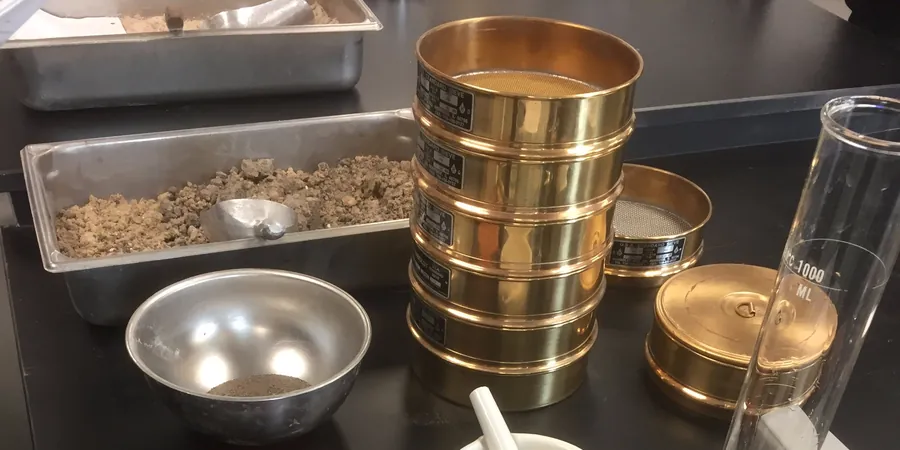
In Chatham-Kent's glaciolacustrine clays, the hydrometer fraction below 2 µm often drives plasticity behaviour and frost susceptibility.